Why are online games free? How game sites make money
Online games are free because ads pay for them. On California Games, a game can ask for an ad break, but the portal decides: no break before about 60 seconds of play, a growing gap between breaks and at most 8 per hour. Rewarded ads are optional, and developers earn half of the ad revenue their games bring in.
There are no in-game purchases, subscriptions or paid tiers. Below is exactly how the money works, with the real numbers.
How do free game sites make money?
Free games on the web are usually paid for in one of three ways: ads, in-game purchases or a subscription. California Games uses only the first. Games published here may not sell items, link to external payments or show ads of their own, so every ad goes through the portal and follows the same rules.
That choice has a cost for us: ads are the only income. It also has a benefit for you: the rules below apply to every game, whoever made it, and no game can squeeze in extra ads.
Why are online games free if ads are so short?
Because many short breaks across many players add up. Advertisers pay for ads that are actually seen, and that money covers servers, the games and the people who make them. A single player sees few ads, but the portal serves a lot of players, and that is the whole model.
How often do ads appear?
Less often than most people expect. These are the portal's default rules today, applied the same way in every game on the website:
| Rule | Default value | What it means for you |
|---|---|---|
| First break | After about 60 s of actual gameplay | Menus and loading screens do not count |
| Gap between breaks | 2 minutes, plus 30 s for each break in the last hour | The longer you play, the further apart they get |
| Longest gap | Up to 5 minutes | The growth stops there |
| Hourly cap | 8 breaks per hour, across all games | Reloading or switching games does not reset it |
| After a rewarded ad | No break for 30 s | You are not hit twice in a row |
| Nothing to show | The game does not even pause | No empty screens, no waiting |
The history that enforces the cap is kept in your own browser, so the limit follows you from one game to the next.
Who decides when an ad shows, the game or the portal?
The portal. A game asks for a break at a natural pause, such as the end of a level or a game over, and the portal checks the rules above before showing anything. If the answer is no, the game simply carries on.
Banners follow the same idea. A game can show one on a still screen, like the menu or a game over, but there can be at most 2 at once, each one changes at most every 30 seconds and nothing shows while the tab is hidden. An impression only counts when the banner is at least half visible for a second, and the portal checks that, never the game.
Do you have to watch rewarded ads?
No. A rewarded ad is one you choose to watch in exchange for something, and the button always tells you what. Two examples from the catalog:
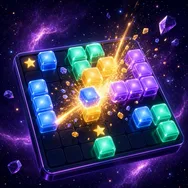
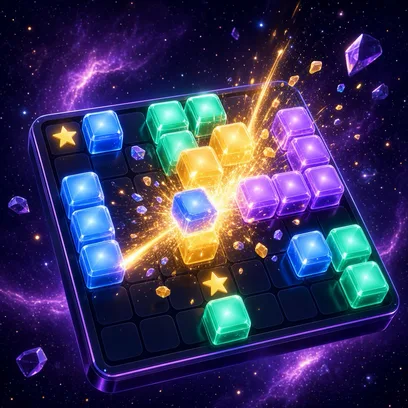
- In Magic Block, when you run out of room you can revive once by watching a video, and the fullest rows and columns disappear.
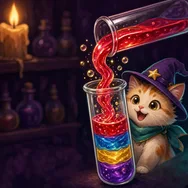
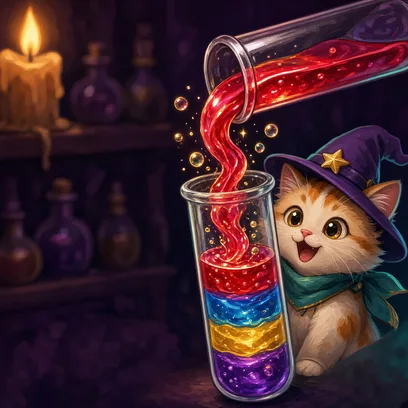
- In Purr & Pour, you get one free extra flask per level, and a second one with a video, if you want it.
You can always close a rewarded ad early with Close without reward. Because you asked for it, a rewarded ad does not count toward the hourly cap.
Who are the advertisers, and what do they know about you?
Ads on the website come from our own ad system, not from an ad network. They are campaigns from advertisers who buy directly from us, or promotions of other games on the portal. Every campaign is reviewed before it runs and must be legal, honest and suitable for a general audience.
- Ads are chosen by game, category, language and type of device, never by a personal profile.
- We do not use advertising or cross-site tracking cookies.
- No personal data is shared with advertisers; they only get aggregated reports.
- Clicking an ad opens the advertiser's site in a new tab, so your game stays where it was.
In the California Games apps, ads come from Google AdMob instead, set to content suitable for all audiences.
How do game developers get paid?
From the ads in their games. A developer receives 50% of the net ad revenue their game generates on the website, or 80% on the players they bring with their own referral link. Publishing is free, and there is no exclusivity.
Most games in the catalog today are made by our own studio, but independent developers can publish too, and they go through the same review. If you make HTML5 games, the developers page explains how it works.
Is there a catch?
Not a hidden one. We do not sell personal data, and nobody pays to appear in our guides or lists, including our best free online games picks. Ads are always labeled as ads (Advertisement on breaks, Ad on banners), so you can tell them apart from the games.
What we do collect is listed in the privacy policy, and how we write and test, in our editorial policy. If you are a parent, the guide on whether online games are safe for kids covers ads from that angle.
Frequently asked questions
Can I pay to remove the ads?
No. There is no paid plan: ads are the portal's only income, and the limits above keep them short and spaced out.
What happens if I use an ad blocker?
The games still run, and ad breaks do not show. Some games hide their reward buttons, since a rewarded video cannot play, so you may miss extras like a revive.
Why did I play for a while without seeing any ad?
Several rules can lead to that: the first minute of play never has a break, the gap between breaks grows during the hour, and when there is no ad to show, the game continues without pausing.
Do the ads follow me to other websites?
No. The portal does not use advertising or cross-site tracking cookies, and ads are picked by the game and context, not by who you are.
Does the developer decide how many ads I see?
No. The developer can only ask for a break at a pause point. The portal applies the same rules to every game, and only the portal confirms an impression.